The bicycle chain gets the least attention amongst the system of parts that made up the bicycle. Yet, it performs the most important function to transmit our pedal power to the rear wheel. Joint by plates, pins and rollers, its lubrication is the key to minimise transmission lost as well as wear and tear.
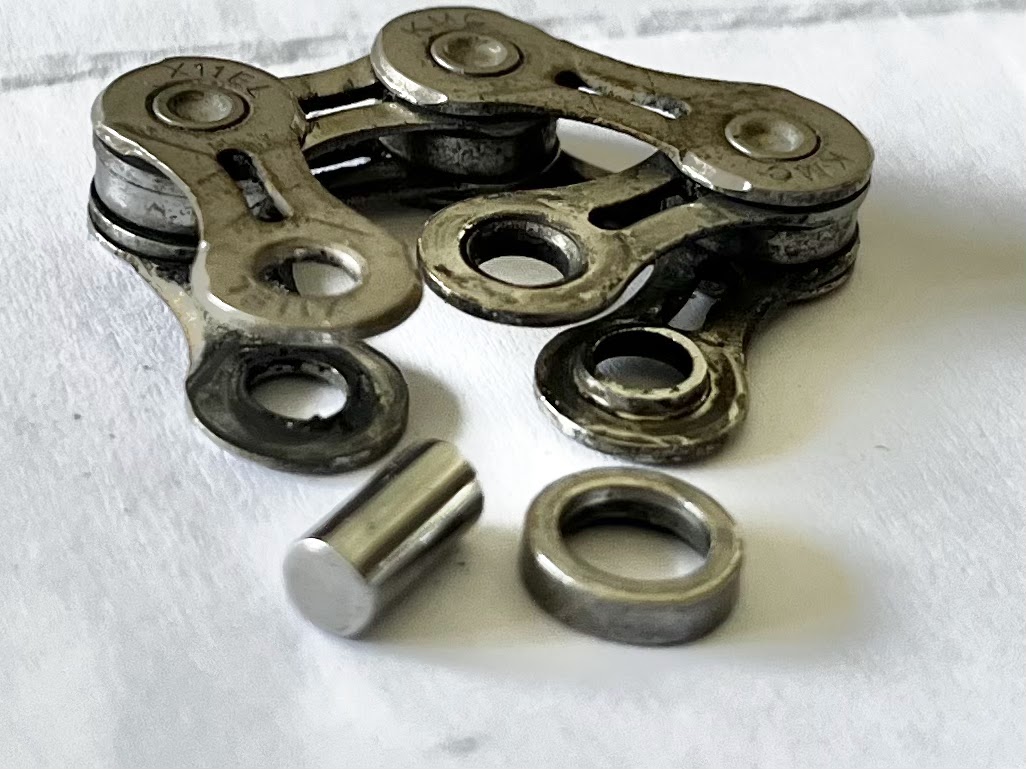
An old oiled chain after soaking and cleaning in a solvent for several days.
Waxing and oiling are the 2 common chain lubrication. Each has it’s advantages and drawdbacks from the total lifecycle perspective. Let’s dive a little into it.
OILING
This is the most common and it is a form of WET lubrication. The lubricant sticks around the metal surfaces, providing a thin film to allow metal to metal surfaces to slide with lower friction. Being in a fluid state, it is able to flow back onto the metal surface after being forced out under load.
While it sticks to metal surfaces, it also attracts dirt and road grime like a magnet. Being fluid, as it moves around metal surfaces when worked on, this acts as a pump to bring in dirt particles that acts as abrasive substances between the metal surfaces. This is the main cause of wear in a chain.
This oily, sticky paste is the common black goo that sticks to everything that it contacts with and it is the most dreded part in cleaning the bike.
WAXING
This is a form of DRY lubrication where the lubricant adheres to the microscopic valleys of the porous metal surfaces providing a thin low friction firm for the metal surfaces to glide over. Being in a solid state, it doesn’t flow and will get squeezed and falls off under load. WAX in itself is not as good as oil in lowering the friction across metal to metal surface. It has to work along another DRY friction modifier to get an optimal result. WAX effectively function as a glue to adhere microscopic friction modifiers onto the metal surfaces to provide that lubrication function.
Wax does not atracts dirt particle and will flakes and falls off when load is applied. Excess are pushed out leaving friction modifiers around the microscopic valleys of the pourous metal surfaces to continue to provide the lubrication function.
Cleaning becomes easy by wiping down with a moist cloth when it is not too dirty and hoisting it off with water and a quick wipe down when it gets very dirty without dealing with all those black gooey stuff.
The difficult part about waxing is the initial chain preparation to removes all traces of oil so the wax can adhere to the metal surfaces.
Maintainence
With all things, everything wears down and degrades with time and usage. Regular maintenance is required to keep things in a desired functional state.
Oiling is easy. Wipe off the old with solvent, apply a blob onto each roller, turn the crank a few rounds to work the oil into the rollers and wipe off the excess. This can be done easily out in the field.
To do a proper hot waxing, the chain needs to be removed, rinsed in boiling water, then dipped in a melted wax bath, wait for it to cool, break the chain and put it back on. This becomes impossible in the field.
Drip Wax are available in the market as an emulsion. It is thick and does not penetrates well into the rollers and pins and leaves a thick sticky chunk on the outside of the chain. It builds up over time and is difficult to clean after.
So, I did my own research, study, experiment and eventually came up with my own system. Yes, chemistry, mechanics and human factors.
Hot Wax – This is still the GOLD standard in waxing. This is a blend of friction modifiers in melted wax ideal for new chains. While this formulation can waxed a new chain with factory oil on, it is best to remove as much factory oil from the chain before treating the chain. It does not need to rigourously removes all traces of oil from the chain before treatment.
Liquid Wax Converter – This is a solvent based liquid wax with friction modifiers and oil polymerizer to convert an oiled chain to a waxed chain. Remove existing gooey gunk from the chain (recommended, not mandatory), apply a drop to each roller and let it dry 4-6 hrours. If your chain has a thick gooey gunk on it, without cleaning that gunk off, it will take a few applications to removes the existing oil before the wax will stay on. If you do not wish to do any hot waxing, you can use this on your new chain. It is recommended to remove as much factory oil from the new chain before applying to reduce wastage.
Liquid Wax – This is a solvent based liquid wax with friction modifiers for the maintenance of the waxed chain. Just like how you would do with a wet lube, wipe off any dirt from the chain with a moist cloth and apply a drop onto each roller and leave it to dry for 4-6 hours. This contains cleaner that will removes wax buildup, leaving a thin layer of wax after drying.
Mixing oiling and waxing chain – For practical reasons, through the life of the chain, there may be occasions you need to re-lube your waxed chain with oil. This system allows the switching between the 2. This is where the Liquid Wax converter comes in.
Why Liquid Wax ?
I am not satisfied with the emulsion waxed available on the market which led me to experiment and developed this liquid wax. It has a very low viscousity that penetrates deep into the roller and pins and leaves a thin visible layer of wax after drying without gunking up. It does not built up over reapplication. One thing to note, though, is to put some towels under to catch the drips and apply it in a well ventilated space.
I am making the system available as follows :
Hot Waxing – Only as a service at $30 for first time treatment (recommended for new chain) and $20 for rewaxing.
Liquid Wax Converter – Available at $15 for a 50ml bottle.
Liquid Wax – Available at $10 for a 50ml bottle.
 (無極騎)TaiJi Cycling